OneValley

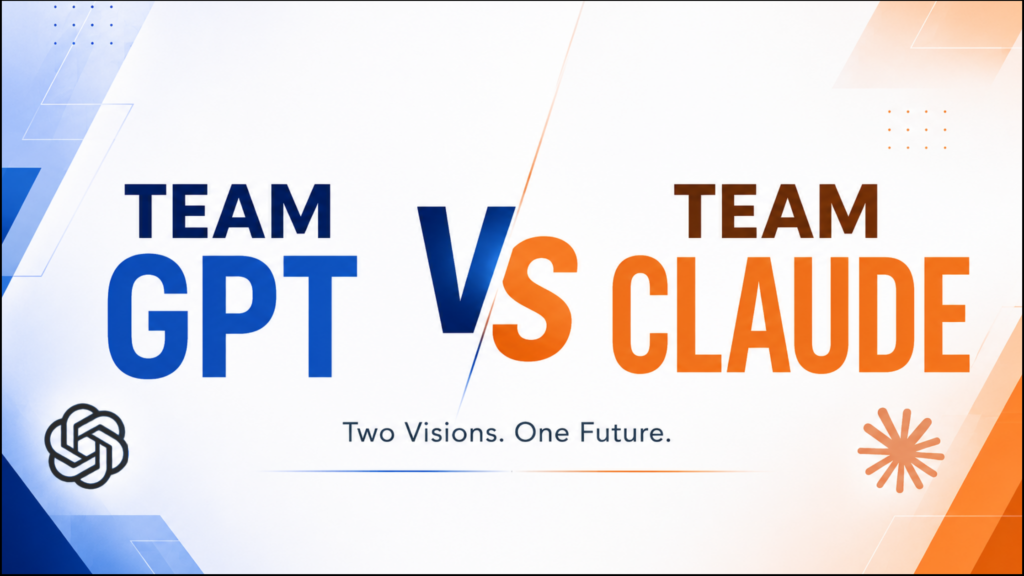
Team-Chat-GPT-VS -Claude

Team GPT vs. Team Claude: The Rivalry That’s Reshaping AI

In 2021, two siblings made a decision that changed the AI landscape and created one of the greatest rivalries of our generation. 

Dario and Daniela Amodei left OpenAI in their roles as VP of Research and VP of Operations to start their own company. They took 15 of OpenAI’s key researchers with them, and Anthropic was born. 

5 years later, in June 2026, Anthropic closed a Series H funding round at a $965 billion valuation, surpassing the valuation of OpenAI’s $122B March funding round ($852B) and officially dethroning OpenAI as the world’s most valuable private AI company.

Now, they’re making a play for Wall Street. Anthropic officially filed for a confidential IPO, and OpenAI rushed to file their own paperwork just days later.

Before there was GPT vs Claude, there was Altman vs Amodei

Behind the rivalry of the logos lies a deeply personal feud between the two founders: Sam Altman and Dario Amodei. 

OpenAI was established in 2015 as a non-profit organization with a goal to “advance digital intelligence in the way that is most likely to benefit humanity as a whole, unconstrained by a need to generate financial return.” Four years later in 2019, they accepted a $1 billion investment from Microsoft.

They began transitioning to a “capped-profit” model, sparking conflict between internal researchers that wanted to prioritize safety and those that wanted to prioritize commercialization. 

OpenAI CEO Sam Altman wanted to scale and deploy as quickly as possible to achieve Artificial General Intelligence (AGI)—a hypothetical AI capable of matching or exceeding human intellect across any task. At its core, AGI would be able to learn on its own and have common sense, creativity, and emotional understanding. 

Dario Amodei, wary of the potential dangers of AGI, wanted to focus first on interpretability and transparency before launching. 

The framing was simple: Altman wanted to move fast, but Amodei wanted to move safe. 

So Amodei left and started Anthropic as a Public Benefit Corporation, a novel corporate structure that requires directors to balance profit-making with public benefits and achieving their social mission. Essentially, Anthropic was established to prove to OpenAI that they could be profitable while sticking to their values. 

What would win? Commercialization or safety? 

In 2019, Altman and Amodei were split as they first clashed over OpenAI’s commercial pivot. In 2021, the companies were split when Amodei walked out to build Anthropic. Now, in 2026, the public itself is split, choosing between OpenAI’s rapid scaling and Anthropic’s strict adherence to its ethical guardrails.

Philosophical Differences Playing Out In Architecture

OpenAI uses an adaptive model.  

They use a technique called Reinforcement Learning from Human Feedback (RHLF). Humans rate the AI’s responses and the AI gets better at understanding preferences. The result is a conversational and charming assistant. But, it also has a higher risk of sycophancy.

Anthropic uses a principled model. 

They pioneered a method called Constitutional AI (CAI), where the AI is forced to adhere to a specific set of written principles (a constitution) rather than relying solely on human feedback in an effort to keep it helpful, honest, and harmless. This explains why at times Claude may feel a little more preachy and is more likely to refuse prompts. This also means that it is less likely to be peer-pressured by the user into generating harmful outputs. It would rather stay silent than risk breaking the constitution.

You can see these differences play out most clearly in how each company markets itself.

Chat GPT- Ad
Claude Ad

OpenAI presents itself as the platform of the future. Their advertisements make the technology feel futuristic and like a life hack. They highlight the versatility of their multi-modal features, so ChatGPT turns into a personal assistant that has eyes, ears, and a mouth.

Anthropic’s advertisements show Claude as a co-collaborator, with their tag line: Keep thinking. Instead of doing the work for you, they want Claude to work with you. It really embodies Anthropic’s belief that AI is a tool to be used by the human itself, not to replace the human.

At a Glance: OpenAI vs. Claude

(Figures accurate as of May 11, 2026. Verify before building.)


GPT vs Claude: Technical API Specs

It’s not uncommon to be Team Claude one week and Team GPT the next. Users often rotate between the two depending on what they’re working on, especially as they battle to release the newest models. However, there are some key differences to keep in mind.


Context Window & Speed

Perhaps one of the biggest technical differentiators between OpenAI and Anthropic is the context window and response speed.

AI-based Speed Regulation

OpenAI’s GPT 5.4 series ranges from 128k to 1M tokens, but charges a “long-context surcharge” for utilizing the upper ends of the context window. That said, when it comes to speed, their GPT-5.3 Codex-Spark model is currently the benchmark for raw throughput, hitting over 1,000 tokens per second. If you’re building a real-time pair programming tool, OpenAI may be the only choice that doesn’t feel like you’re waiting for a dial-up modem.

User-based Speed Regulation

Claude’s top-tier models handle a 1 million token context window with a flat pricing model that prevents hidden fees when processing massive files. While generally slower on raw output speed, models like Claude Opus feature effort control toggles that let you prioritize fast responses or deep reasoning. Anthropic also offers a highly granular prompt caching system with manual breakpoints. 

(Pro Tip: This is a massive cost saver for RAG-heavy startups that need to pass identical, large datasets—like a 500-page technical manual—with every single query.)

It comes down to the rhythm of your product. If you need quick, iterative bursts where latency kills the user experience, choose OpenAI. If your app requires deep, high-fidelity synthesis of massive data where you can trade a few seconds for better accuracy and flat-rate pricing, Anthropic is the more mature platform.

Agent Infrastructure: Walled Garden vs. Open Standard

When it comes to actually making your AI do something useful like updating a database or triggering a payment, both companies have moved far beyond basic chat. They are essentially competing to be the operating system for your agents.

Apple-esque All-in-One

True to brand, OpenAI has doubled down on the all-inclusive experience. Their Responses API is designed for the founder who doesn’t want to manage a complex stack. It handles the difficult infrastructure work like file storage and thread history for you. If you need your AI to output a specific format, OpenAI’s JSON Mode is remarkably consistent. It acts as a hard constraint to ensure the model never sends back malformed code that might crash your frontend. Building on OpenAI feels like using a high-end managed service where you trade some control for the ability to ship a product in a single weekend.

Á la Carte Integrations

Anthropic took a more modular approach by introducing the Model Context Protocol or MCP. Instead of hosting your data or managing your tools, they created an open standard that allows Claude to connect to any data source whether it is a local Postgres database or a company Slack. By 2026, MCP has become the universal remote for the AI world. It was even donated to the Linux Foundation to ensure it stays an open standard. This makes Claude the favorite for developers who want to avoid vendor lock-in. You don’t have to rebuild your integrations if you decide to switch models because the MCP server stays the same.

The rivalry here is easy to spot. OpenAI wants to own the entire walled garden and give you every tool in one dashboard. Anthropic wants to be the smartest brain that plugs into whatever custom setup you already have.

Codex vs. Claude Code

The landscape of AI-native engineering has shifted from predictive text to employing a digital The landscape of AI-native engineering has shifted from predictive text to employing a digital engineer residing within your terminal. OpenAI’s Codex has transitioned from a basic model into a potent “Background Agent,” tailored for the visionary who prefers to delegate. Anthropic’s Claude Code, conversely, represents the “Pair Programmer” that invites active dialogue.

Set it & Forget it

OpenAI’s background agent is engineered for autonomous, cloud-based execution. It operates remotely in a secure sandbox, absorbing your GitHub tickets and running test environments entirely out of sight. By 2026, the industry sentiment has solidified: for those looking to delegate heavy back-end overhauls or run parallel tasks across multiple branches, Codex is the choice. Its execution is famously hands-off, frequently optimizing for speed and minimal token overhead to guarantee that the logic is deployed without clogging your local machine. Designed for the founder who values high-throughput delegation, its multi-agent functionality triggers independent workflows until the task succeeds, establishing it as the preferred option for teams who favor automated scale over Anthropic’s “pair-programmer” local methodology.

Collaborative Coding

Anthropic’s CLI is engineered for synchronous, live collaboration. It operates natively on your local hardware, absorbing your directory architecture and running terminal commands in plain sight. By 2026, the industry sentiment has solidified: for those looking to manifest a frontend feature or clean up complex React code, Claude is the choice. Its responses are famously comprehensive, frequently utilizing triple the token overhead of Codex to guarantee that the logic is idiomatic and fully documented. Designed for the engineer who values staying in the zone, its recursive “loop” functionality triggers live debugging sessions until the tests succeed, establishing it as the preferred option for developers who favor local transparency over OpenAI’s “black box” cloud methodology.

For a non-technical founder who just wants to build without touching a semicolon, the choice between OpenAI and Anthropic comes down to how much you want to be involved in the process. 

Codex is more of a manager. With its cloud-based agentic system, you just have to give it a high-level goal, and it will spin up multiple agents in the background to handle the work in parallel. Since it operates in a cloud sandbox, you don’t even need to have a code editor open on your laptop. 

Claude Code is more of a creator. It lives in your terminal and works alongside you in real-time. It doesn’t just go off and do things, it talks you through the plan. For a non-technical founder, this visual feedback loop is a massive advantage. You’ll see your app taking shape frame-by-frame, making the whole experience feel more intuitive. 

The logic matters too. Since Codex uses o-series reasoning, it can be incredibly good at solving hard math or logic problems on the first try. Standard models immediately try to guess the next word, but o-series models use chain-of-thought instead: breaking down complex models, correcting mistakes, and testing multiple approaches before giving you an output. But, it can feel like a black box. You give it a prompt, it thinks for a bit, then gives you out a thousand lines of code. Claude Code is notoriously more thorough and chatty. It will often catch its own mistakes before it even starts writing, and it tends to follow your instructions with more precision. 

Vibe coding with OpenAI makes you feel like a CEO who delegates to an outsourced engineering department. Vibe coding with Anthropic makes you feel like you’ve got an incredibly ambitious intern who won’t stop explaining their reasoning to you.

The Cultural Moment

One of the biggest mistakes a founder can make is declaring loyalty to any single brand instead of prioritizing actual needs. With the fast-changing nature of AI, things can flip-flop at any moment.

In the early months of 2026, we saw a huge cultural shift towards Anthropic with their release of Claude Opus 4.6. While GPT was still mostly a chat and response machine, Opus 4.6 introduced native agentic planning. It could look at a multi-repo codebase, map out a three-day refactoring plan, and then execute it step-by-step with almost no supervision. 

Another factor in the shift: In February, Anthropic walked away from a $200 million Department of War contract, refusing to strip safety guardrails that blocked Claude from being weaponized for autonomous warfare and mass domestic surveillance. 

Cultural Moment Chat GPT VS Claude

OpenAI immediately swooped in hours later to claim the classified military deal under a more permissive “all lawful purposes” framework, sparking fierce backlash and a wave of cancellations from privacy-conscious developers. 

This was the first major consumer “ethical revolt” of the AI era. 

While OpenAI secured massive defense revenue, Anthropic’s willingness to sacrifice millions to defend its morals ultimately built an unbreakable enterprise moat, winning deep loyalty from founders who wanted an AI partner that wouldn’t compromise their data or ethics for a government payout.

Within 48 hours of OpenAI announcing the deal, over 1.5 million users canceled their ChatGPT Plus subscriptions almost immediately. This sudden exodus wiped out an estimated $360 in projected annual recurring revenue overnight. 

Of course, Anthropic’s ads during the Super Bowl LX helped sell their brand even more. They took a direct shot at OpenAI, making fun of ChatGPT’s tendency to agree with everything the user says and, most importantly, their decision to start including ads inside the product itself. Anthropic positioned themselves as the professional choice––clean, ad-free, and focused on work rather than selling you dating site memberships in the middle of a debugging session.

Ads are coming to AI mnot Claude

Even so, just as soon as Anthropic rose, they began to fall. From March through April, developers started to feel like something was off with Claude. Anthropic had quietly changed the default reasoning effort for Claude Code from high to medium to reduce latency and save on compute costs, but the result was a noticeable drop in coding quality. Developers who were used to Claude solving complex architectural problems suddenly found the model giving lazy answers or skipping difficult refactors. Anthropic eventually admitted that this change, combined with a bug in how thinking blocks were managed, caused the model to lose its train of thought in long sessions.

Update on Claude

Meanwhile, OpenAI released their GPT 5.5 Instant, one of the fastest models available. They showed off their new Memory Source feature, allowing the API to draw context from past chats, uploaded files, and even your Gmail data (if you opt-in). They doubled down on their earlier bet that a model that knows your life will be more valuable than a model that knows a protocol. In a total flex of raw compute, OpenAI revealed that GPT-5.3 Codex was actually used to debug its own training and deployment. They are leaning hard into the narrative that their models are more hardened because they are being built by the AI itself.

Looking to regain the narrative, Anthropic fired back by opening the gates to Claude Mythos: a frontier model they had teased for months as too dangerous for public consumption due to its autonomous cyber-offensive capabilities. When the preview finally dropped, its raw reasoning wowed the industry, but it instantly triggered an immense developer backlash. To run effectively, Mythos demanded sweeping data and intrusive privacy permissions. Worse, Anthropic included a highly controversial clause stating the model would actively poison its own outputs and degrade performance if it detected a user was secretly using Mythos to train a competing AI. The heavy-handedness backfired completely, but the corporate drama was short-lived: just days later, the federal government stepped in, effectively banning Mythos by leveraging strict national security export controls after a Senate hearing revealed the model had autonomously breached classified networks in a matter of hours.

The combination of Anthropic’s reliability issues, the Mythos lockdown, and OpenAI’s new release pulled some users back to OpenAI. But, OpenAI can’t quite claim victory . The GPT 5.x family has been plagued by complaints of laziness. Developers documented a sharp increase in “skeleton coding”: instead of providing full working implementations, the new GPT-5 models have started returning abbreviated snippets with comments like “// insert your logic here //.” This is likely a result of OpenAI’s new tiered inference system, which routes queries to lighter models to manage server load. For a developer, it can be infuriating to pay for a flagship model only to realize the API is secretly handing your task to a smaller mini version to save a few cents on compute.

The Final Battle of the Chatbots

Just for fun, we wanted to see what ChatGPT and Claude think of each other (plus, Gemini as a neutral third-party). We asked all three chatbots the same question. Here’s what they had to say.

What ChatGPT thinks about Anthropic (Screenshot):

Chat-GPT-Thoughts-on Rivals

What Claude thinks about OpenAI (Screenshot):

Antropic-thoughts-on riavals

What Gemini thinks about OpenAI or Anthropic (Screenshot):

Gemini Thoughts on Rivals

Every chatbot gave us a diplomatic response. They all agreed on the same conclusion: choose based on your product needs, not the brand.

The Real Lesson

One of the biggest mistakes a founder can make is declaring full loyalty to any single AI company instead of prioritizing actual needs, because with the fast-changing nature of this industry, things can shift at any moment.

The most important takeaway from these past few months is to never hard-code yourself into a single provider. New releases will always be coming. The smartest way to build is the one that keeps you model-agnostic.

Want to go deeper on the technical differences like pricing, APIs, context windows, and how to actually choose between them for your product? 

Reliability: What’s Actually Been Happening

Neither platform has been flawless lately, and you should know what you’re signing up for.

On the Anthropic side, from March through April 2026, developers noticed a meaningful drop in Claude Code quality. Anthropic had quietly changed the default reasoning effort from high to medium to reduce latency and cut compute costs. The result: complex architectural problems started getting lazy answers or skipped refactors. Anthropic eventually admitted the change, combined with a bug in how thinking blocks were managed, caused the model to lose its train of thought in long sessions.

OpenAI has faced similar complaints. The GPT 5.x family has been plagued by what developers are calling “skeleton coding” — instead of full working implementations, the models increasingly return abbreviated snippets with comments like // insert your logic here //. The likely cause is OpenAI’s tiered inference system, which quietly routes queries to lighter models to manage server load. Paying for a flagship model and getting a mini is not a great experience.

The pattern from both incidents is the same: both companies have made silent optimizations that traded quality for cost savings, then faced developer backlash. Build with that in mind.

The Decision Matrix

Choose OpenAI if:

  • Latency is critical and you’re building real-time, iterative experiences
  • You want multimodal capabilities (voice, video, image generation) native to the API
  • You’d rather trade control for a fully managed infrastructure stack
  • Your use case involves discrete, well-defined tasks where the o-series reasoning shines

Choose Anthropic if:

  • You’re working with large codebases, long documents, or complex multi-file reasoning
  • You want flat pricing on high-context usage without surprise surcharges
  • You’re building agents and want to avoid vendor lock-in via MCP
  • Compliance, safety, or enterprise trust is a priority for your customers

Use both if:

  • You’re building a production AI stack and can afford to route tasks dynamically
  • You want to future-proof against either company’s next silent optimization

The Most Important Rule

One of the biggest mistakes a founder can make is declaring full loyalty to a single provider instead of prioritizing actual needs. The combination of Anthropic’s reliability issues and OpenAI’s skeleton coding complaints over the past few months has made one thing very clear: never hard-code yourself into a single provider.

New releases will always be coming. The smartest architecture is the one that keeps you model-agnostic.

Follow us today and have the latest updated scoop to understand the AI race, before choosing your AI strategy! Don’t forget to read or 3 part AI Reality Series!

For the full story on how this rivalry started (and what it means for the future of AI) read Part 1: The Rivalry →

About OneValley

OneValley is a global entrepreneurship platform providing founders, accelerators,, corporations, foundations and governments with the resources, network, and tools to innovate faster. Its Passport platform connects thousands of startups and programs, to OneValley’s global network, curated perks and discounts as well as an application manager with vetted questions.

Learn more about Passport here!

Discover More blogs for Growing Innovation Ecosystems

Building the future starts with the right connections!

Team GPT vs. Team Claude: The Rivalry That’s Reshaping AI

Team GPT vs. Team Claude: The Rivalry That’s Reshaping AI

GPT-5 vs Claude: Explore coding, context windows, AI agents, pricing,…

OneValley partners with Zeki Data to bring talent intelligence to its global founder ecosystem

OneValley partners with Zeki Data to bring talent intelligence to its global founder ecosystem

OneValley and Zeki Data partner to deliver AI talent intelligence,…