It has never been easier for a startup or their product to look credible. A working demo, a slick interface, a foundation model doing the heavy lifting underneath: any competent team can put that together in a weekend. By now, the industry is realizing that startups that are just building thin wrappers around frontier models or that are vibecoding non-differentiated SaaS solutions face extinction, because the thing they built stopped being scarce.
We sat down with Kate Seledets, Principal at OneValley Ventures, to ask a simple question. Has AI made her job easier or harder? Her answer, in short: the tools got better, but so did everyone’s ability to see through them.
“AI has made it much faster and less expensive to build and launch a credible product,” Kate shared. “As a result, investors increasingly expect founders to test their assumptions, get in front of customers, and learn faster.” The cost of iteration is lowered, and the feedback loop of build-test-build-test has accelerated, moving the bar.
Kate flagged something most general advice glazes over: The benchmarks for AI companies aren’t universal, and they depend on stage and business model as much as anything else. “A company raising its first capital should not be evaluated against Series A revenue or retention metrics,” she said. At that stage, she’s looking at something narrower: the team, the insight behind the company, the importance of the problem, product velocity, and the quality of the earliest market evidence.
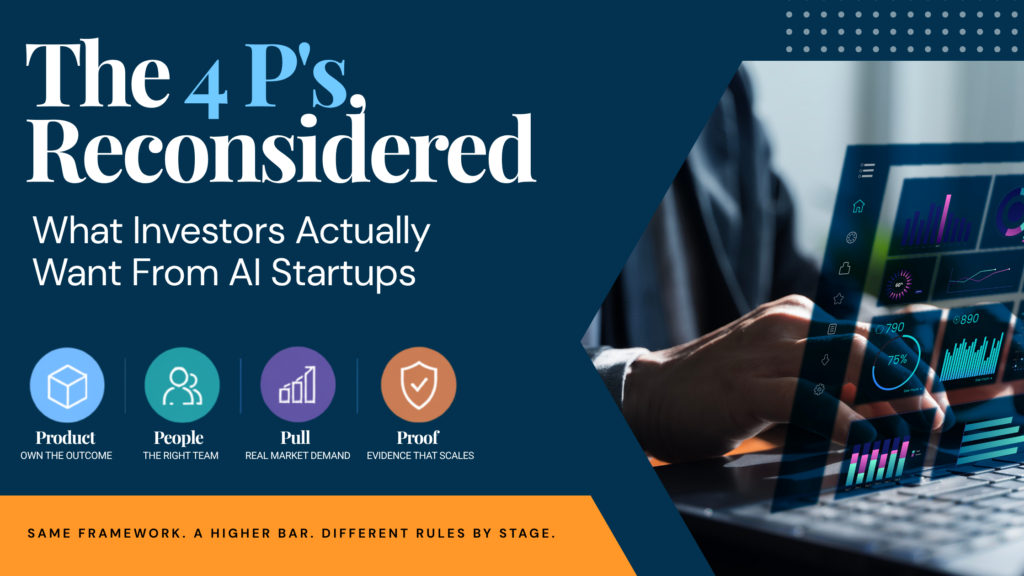
We previously built our 4 P’s framework to capture what investors and accelerators evaluate in AI startups: Product, People, Pull, Proof. Talking with Kate confirmed that the shape still holds. What’s changed is the depth underneath each one, and what “good” looks like has splintered by stage.
Product: Own the outcome, not the model
Kate’s read on Product cuts against a common founder instinct right away. “I would focus less on whether a startup has built its own model and more on whether it owns an important workflow or delivers an outcome customers genuinely value,” she said. “A company can use third-party models and still build a defensible product.”
Where does this defensibility actually come from? In her view, it starts with access to unique data that competitors can’t easily obtain, especially when the product generates additional data through usage and uses it to improve over time. From there, she points to deep integrations, accumulated customer context, feedback loops, distribution, and switching costs. The test she applies to all of it is the same: whether the company’s advantage gets stronger as it gains users and as the underlying models improve, rather than being erased by the next model release.
Marc Andreessen made a related argument on a16z’s own podcast back in January, pushing back directly on the “GPT wrapper” critique of application companies like Cursor. He said the common assumption, that these companies are just pass-through shells surfacing someone else’s AI, gets the direction backwards. In practice, he argued, the leading application companies start out using a single model and end up orchestrating dozens, and the strongest ones eventually build their own models because their domain understanding lets them build something better suited to the problem than a general-purpose model ever could.
Kate added one more piece founders tend to skip. “Product quality also includes reliability, security, accuracy, and the ability to fit into existing workflows,” she said. “A compelling demo is no longer enough if the product cannot perform consistently in a real-world environment.”
Harvey, the legal AI company, is a clear, real-world example of what happens when a startup gets this right. It runs on the same foundation models available to any competitor, from OpenAI, Anthropic, and Google, but fine-tunes them on proprietary legal data and case law, and embeds the product directly into how large law firms already work rather than asking them to adopt something new alongside it. The results are evident in their numbers: Harvey’s valuation has tracked its actual revenue growth rather than outpacing it, moving from an $8 billion valuation in December 2025 to $11 billion in March 2026 on the back of ARR that nearly doubled over roughly the same window. Now, it serves more than 1,500 customers, including half of the Am Law 100 and the Silicon Valley rumors suggest they are on the verge of a new funding round at a $15B valuation.
People: Can they build it, know what not to build, and reach the people who need it
Technical depth used to be the differentiator, but now it’s just the floor. “Technical ability remains important, but it is not sufficient on its own,” Kate said. What separates strong teams now, in her view, is a combination: technical and product capability paired with real customer understanding, sharp judgment about what to build, and the speed to keep learning as the technology shifts underneath them.
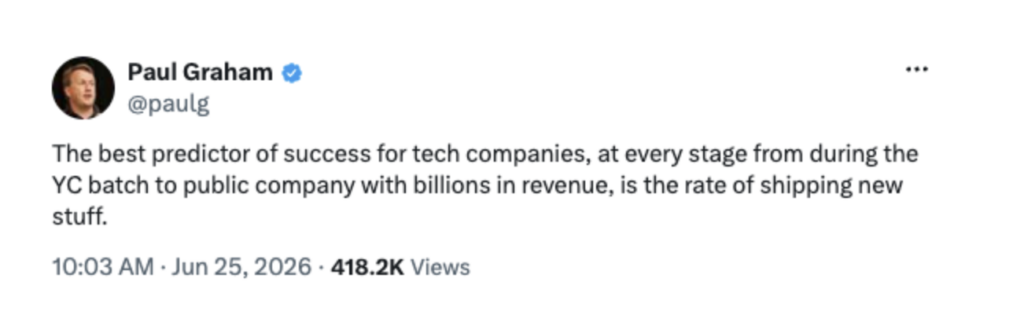
Paul Graham’s tweet echoes this idea perfectly: once you get the right people, you’ll be able to ship new stuff quickly and move towards success.
She flagged two specific skills most founders don’t think to prepare for.
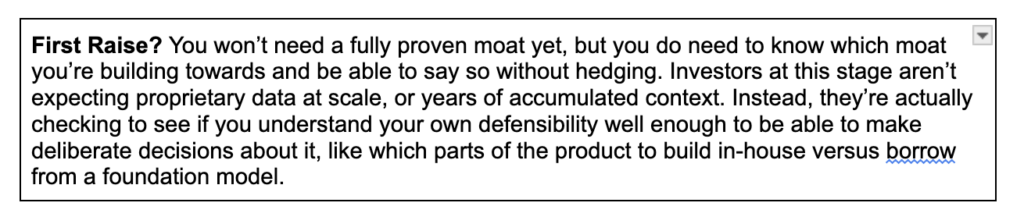
The first is knowing what actually needs to be built in-house. Not every part of an AI product benefits from being proprietary. “Founders should also understand which parts of the product truly need to be proprietary and which can rely on external models or infrastructure providers,” Kate said. Trying to own everything is often a sign a team hasn’t thought clearly about where its real advantage lives.
The second is access. “Existing relationships can help a team validate the problem and secure early adoption more quickly,” Kate said, but she was careful to add a caveat: personal networks only carry a company so far. “Over time, the company will need to show that it can build repeatable acquisition or partnership channels beyond the founders’ personal networks.” A team that can only sell to people it already knows has a ceiling.
Underneath both is a speed requirement. Kate pointed to the ability to adapt as the underlying models change “without losing sight of the problem they are solving.” Teams that treat their own AI stack as fixed infrastructure get outpaced fast.
That pressure is compounding for a less obvious reason: the talent pool itself is younger and less experienced than it looks. In the same a16z conversation, Andreessen noted that some of its best AI researchers working today are in their early twenties, simply because the field hasn’t existed long enough for anyone to have been an expert for longer than four or five years. That cuts against the old assumption that AI talent is scarce and can only be hired away from a handful of established labs. The pool is expanding quickly, and founders who develop that talent in-house rather than compete for the same known names have an opening the market hasn’t fully priced in yet.

Pull: Is there evidence for real demand?
AI is such an easy sell right now that the old signal for demand has gotten noisy. “Because there is so much interest in AI, it has become relatively easy for startups to generate initial curiosity or secure a pilot,” Kate said. “Therefore, the number of pilots or expressions of interest alone does not necessarily demonstrate strong pull.”
Kate’s fix for this is a clear framework of real demand, not a headcount. For enterprise companies, she draws a distinction between a design partnership, a free pilot, a paid pilot, a production deployment, a renewal, and an expansion. She notes that the strength of the demand comes down to depth of engagement. Even a free pilot can be a strong signal when it’s being used in a real workflow, with clear success criteria, an identified buyer, and a defined path to a paid deployment.
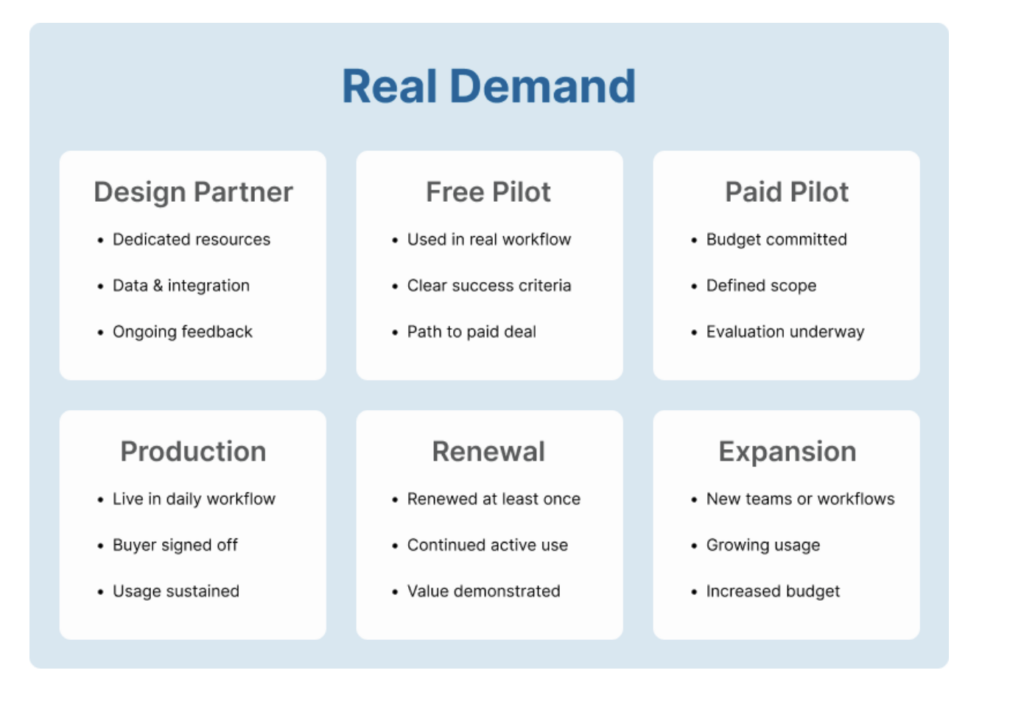
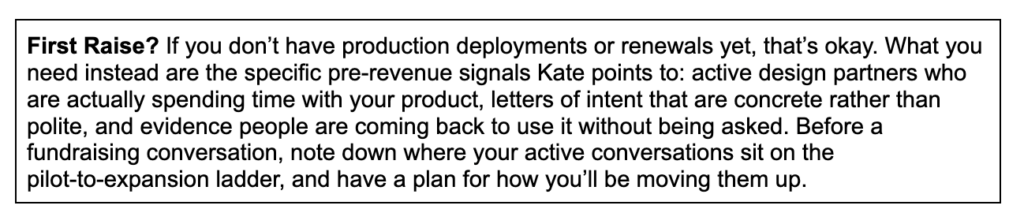
For companies that are still pre-revenue, she looks for a different set of evidence. Active design partners who are putting in real time and resources. Repeated product usage, not a one-time trial. Technical integrations that would be painful to unwind. Specific letters of intent, not vague enthusiasm. Willingness to pay, even if the deal hasn’t closed yet. The question is still the same: is someone choosing this, repeatedly, with their own time or money, or are they just curious?
Underneath all of it, Kate wants founders to answer a simple question clearly: why is this problem urgent, how do people solve it today, and why is the new product meaningfully better than the incumbent, an internal build, or just doing nothing? A founder who can’t answer that crisply usually hasn’t found real pull yet, no matter how many logos are on the pilot list.
Proof: Does the business work at the scale it claims?
Pull asks whether anyone’s genuinely committed. Proof asks if the underlying business will actually hold up. Just like in Product and People, Kate rejects a single universal bar. “The relevant proof depends on the company’s stage and business model,” she said. A company raising its first round of capital doesn’t have the track record a Series A company does, and judging it by the same yardstick misreads the situation entirely. “For a startup raising its first capital, revenue may be limited or may not exist yet,” she said. “I would not expect mature NRR or millions in ARR at this stage.”
What she looks for instead, at that early stage, is a different kind of evidence: the depth of the founders’ insight into the problem. How fast the product is moving, technical validation, real engagement from early users or design partners, willingness to pay even before a deal is signed, and clear signs the team is learning and improving quickly. Proof, even this early, is asking whether the thing being built is technically sound and whether the team building it is moving fast enough to keep it that way.
The shape of proof also shifts by business model, not just by stage. Consumer companies get judged on engagement, retention, and organic growth. Infrastructure companies get judged on technical performance and developer adoption. Deep-tech companies get judged against clear technical milestones. Regulated businesses get judged on safety, compliance, and how well they integrate into existing workflows. A founder pattern-matching their pitch to the wrong category of proof, Kate shared is a common and avoidable mistake.
Once revenue does exist, Kate looks past the headline number to its texture: paid, contracted or recurring; used in production or just licensed; concentrated across a few accounts or spread out; renewing and expanding or flat. Underneath that texture question sits something she treats as a genuine warning sign in AI companies specifically: the true cost of delivering the product. It’s not just model and inference costs. It includes third-party data, human review, implementation, customer support, and the founders’ own engineering time quietly propping up the business. She wants founders to explain how that work becomes standardized and productized over time, rather than calcifying into a services business wearing a software valuation.
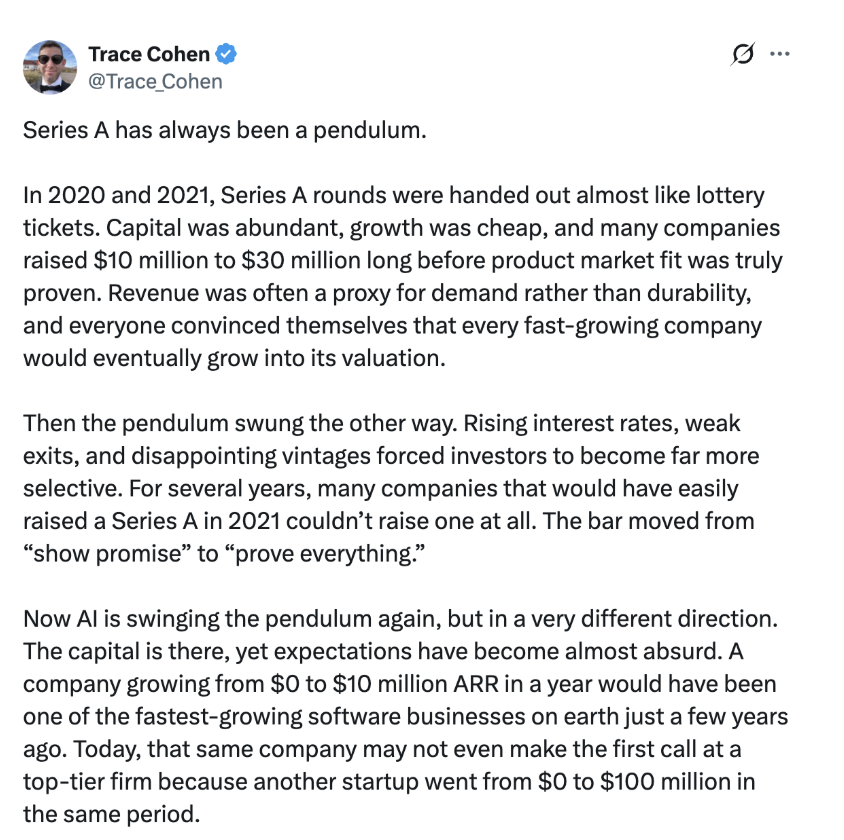
That’s Kate’s own bar, and it’s a stage-appropriate, model-appropriate one. Worth knowing on top of it: even companies clearing that bar are being measured against a moving target. Investor Trace Cohen has described this as a pendulum. A company growing from $0 to $10 million in ARR in a year would have been one of the fastest-growing software businesses on earth a few years ago; today, he argues, that same company might not get a first call at a top-tier firm, because another startup went from $0 to $100 million in the same window.
A strong team and product still need a market big enough to support a venture-scale outcome. Kate wants founders who can name the initial customer or workflow precisely, and who are clear about what the current round is actually meant to prove, whether that’s technical validation, a working product, initial adoption, or early revenue. A round without a specific milestone attached is, in her view, a round without a clear thesis.

Closing
AI made the look of a product cheap to produce. It didn’t make the substance behind it any cheaper to build, and that gap is what our new version of the 4 P’s is designed to expose.

The practical version, if you’re building right now: know which of the areas you’re weakest on, and fix it first. Can you explain your defensibility in a sentence and hold up under a follow-up? Do you know which parts of your product should be proprietary and which shouldn’t be? Can you point to real depth of engagement, not just a pilot count? And can you say clearly what your current round is actually supposed to prove?
Easier to build was never going to mean easier to fund. The founders worth backing right now are the ones who can say, specifically, why theirs gets harder to copy the longer it exists.