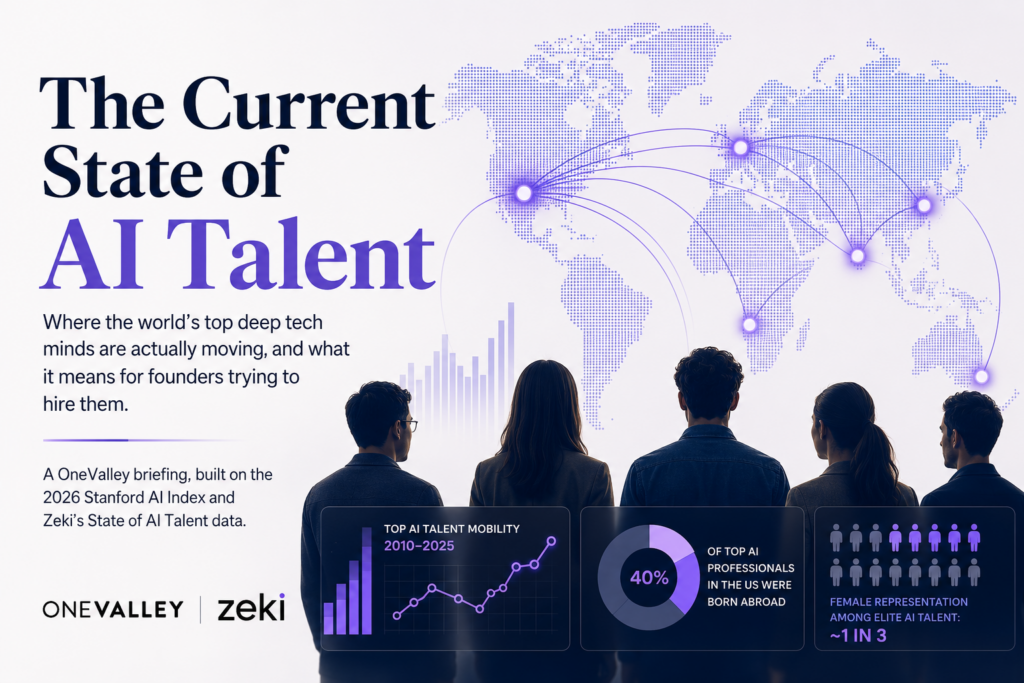
Where the world’s top deep tech minds are actually moving, and what it means for the founders trying to hire them
A OneValley briefing, built on the 2026 Stanford AI Index and Zeki’s State of AI Talent data
The money is still flowing toward US AI startups. The talent is quietly flowing the other way. That gap is the single most important hiring signal for founders right now, and it is hiding in plain sight across two of the most authoritative datasets in the field.
In early 2025, Zeki predicted the US would stop being the default destination for the world’s best AI minds. A year later, the 2026 Stanford AI Index, which uses Zeki as a data source, confirmed it with hard numbers. Here is where elite talent sits today, where it is concentrated, and how to reach it before your competitors do.
The short version
- The US still holds the largest pool of elite AI talent, but its ability to attract new talent has collapsed, down 89% since 2017.
- The US now leans heavily on imported talent. Roughly 40% of its top AI professionals were born elsewhere, and that supply line is thinning.
- Volume and density are different maps. The biggest countries are not the smartest places to recruit.
- The era of the giant engineering team is ending. Smart, targeted hiring beats mass hiring.
1. The magnet is still on, but the pull is fading
The United States remains home to more elite AI talent than any other country, with 220,520 identified top authors and inventors in 2025, more than the next four countries combined.
The problem is the flow, not the stock. The number of AI researchers and developers relocating to the US has dropped 89% since 2017, and 80% of that decline happened in a single year. Zeki saw this coming. Its State of AI Talent report projected that 2025 would be the year the US tipped into becoming a net exporter of top AI talent, with India, the UK, and Germany positioned as the primary beneficiaries as professionals head home.
That matters more than it looks, because the US supply is propped up by imports. Of the roughly 322,000 top AI professionals working in the country, Zeki found that about 40% were born abroad, along with 39% of the people who founded America’s AI companies. When the inbound flow slows, that dependency becomes a vulnerability.
For a founder, the lesson is direct. Assuming the best people will come to you because you are US-based is a strategy with a shrinking success rate. The advantage now goes to teams that know how to find and reach talent where it already lives.
2. Volume shows you where the pools are
Ranked by total elite AI talent in 2025:
- United States, 220,520
- India, 50,460
- Germany, 48,520
- United Kingdom, 34,370
- Canada, 31,450
- France, 18,820
India is the standout. Zeki predicts the country is flipping from a provider of AI talent to a consumer of it, meaning the engineers who once left are increasingly staying home or returning. For founders, that reframes India from a pure outsourcing play into a genuine market for senior, hard-to-poach talent.
3. Density shows you where to actually fish
Volume rewards big countries. Density reveals where talent is genuinely concentrated. Measured per 100,000 people, the ranking flips:
- Switzerland, 110.5
- Singapore, 109.5
- Sweden, 80.6
- Finland, 77.6
- Netherlands, 77.6
- Canada, 76.2
The United States sits at 64.8 on this measure, behind all six. Translated for hiring: a founder recruiting in Zurich, Singapore, or Toronto is fishing in denser water with fewer nine-figure competitors casting into it. These are not backup markets. They are efficient ones.
4. The credential signal
If your build demands research-grade depth, PhD concentration matters. Share of elite AI talent holding a doctorate:
- United Kingdom, 51.1%
- Australia, 50.5%
- Switzerland, 43.6%
- South Korea, 42.5%
- United States, 42.0%
The UK and Australia stand out as the two markets where you are most likely to reach doctoral-level talent, worth knowing before you decide where to open a research function.
5. The pools almost everyone ignores
Two structural gaps in the data double as recruiting opportunities.
First, geography. Talent has spread well beyond the traditional US and China centers, yet most hiring funnels have not. The founders who win the next cycle will be the ones sourcing from markets their competitors overlook.
Second, gender. Female representation among elite AI talent tops out at roughly a third, highest in Saudi Arabia (32.3%), Australia (30.1%), Canada (29.6%), and Italy (29.5%). More striking, that ratio has stayed flat from 2010 to 2025. A pool this large and this underused is an arbitrage for any founder willing to build a search that actually reaches it.
6. The era of the giant engineering team is ending
For a decade, the playbook was simple: raise, then hire in bulk. Zeki’s data shows the top fifteen US AI companies hired roughly half a million software engineers over time, with monthly hiring peaking above 3,000 around 2020. Then it broke. Hiring crashed into net layoffs after 2023 as agentic AI tools spread across engineering orgs.
The Stanford data shows the same shift from the other side. Employment for US software developers aged 22 to 25 fell nearly 20% from 2024, even as headcount for senior developers kept growing. The signal is not that engineers are less valuable. It is that leverage now sits with a smaller number of exceptional people. Hiring the right ten beats hiring the wrong hundred.
What this means if you are building your team
- Do not wait for talent to relocate to you. The inbound flow to the US is drying up. Build for a distributed, source-outward model.
- Recruit by density, not by headline. Switzerland, Singapore, and Canada offer concentrated expertise with less competition than SF or NYC.
- Match the market to the mandate. Research-heavy roles point to the UK and Australia. Cost-efficient scale points to India and Germany.
- Hire sharp, not big. The team-building era has changed. A few exceptional operators now outperform a large average one.
- Widen the funnel on purpose. The most valuable candidates are the ones your competitors’ searches never surface.
The intelligence behind these numbers
Every talent figure in this briefing traces back to Zeki, the deep tech talent intelligence firm named as a data source for the 2026 Stanford AI Index. Zeki scores more than 10 million of the world’s top scientists, engineers, and operators using 50-plus signals of real-world impact, career trajectory, and future potential, then tracks how that talent moves across companies and borders. Its State of AI Talent analysis alone draws on the top 800,000 professionals across 115 countries.
OneValley partners with Zeki to bring that same intelligence layer, and its invite-only hiring marketplace, the Zeki Talent Market (ZTM), to founders in our ecosystem. ZTM surfaces product, engineering, and GTM operators who rarely appear in standard searches and who are typically on the market for only about ten days. Put plainly: the same dataset that told Stanford where the world’s AI talent is heading can tell you exactly who to hire, and help you reach them before anyone else does.
Let’s talk
If you are planning a technical or GTM hire, I can walk you through what the Zeki data says about your specific market and role, and get you early access to ZTM.
Book a 30-minute startup chat: https://meetings.hubspot.com/sel/startup-chat-w-sarina
Sarina El | AI Startup Advisor | OneValley x Zeki
Sources: Talent figures are drawn from the 2026 Stanford AI Index Report, Chapter 1, Section 1.8 (AI Authors and Inventors), which is built on Zeki Data covering 2010 to 2025, and from Zeki’s State of AI Talent report. Both report full-year figures, so the picture here reflects the current structural state of the talent market rather than short-term fluctuations.