Ask most founders whether they have access to talent and they’ll say yes. Between LinkedIn, AI sourcing tools, job boards, referral networks, and the wave of experienced operators who’ve left big tech over the past year, candidates aren’t the bottleneck. Getting to a confident hiring decision is.
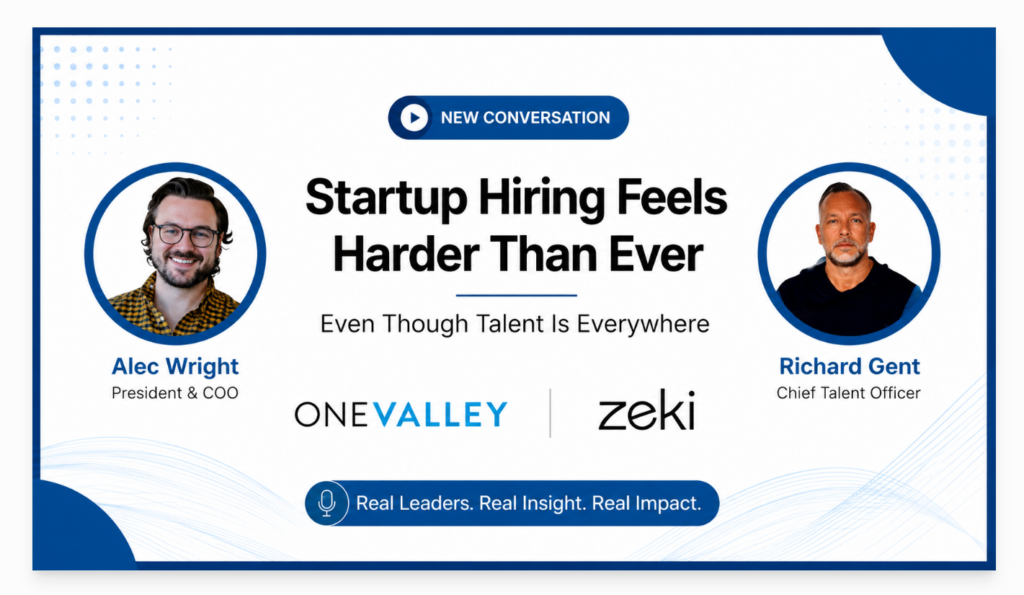
We sat down with Alec Wright, President and Chief Operating Officer at OneValley, and Richard Gent, Chief Talent Officer at Zeki Data, to unpack why that gap exists and what founders can do differently.
Alec has spent the past decade on the investing side of early-stage tech, backing and advising companies through OneValley Ventures — including Tueo Health (acquired by Apple), Kylie.ai (acquired by Directly), and NERv Technologies — and advising innovation teams at Fortune 500s like Cisco, Intel, and JetBlue. From that seat, he’s watched the same pattern play out across dozens of portfolio companies: strong founders, real funding, and still a hiring process that stalls at the exact moments when speed matters most.
Richard has spent over 20 years building and running recruiting functions for organizations including HSBC, Lloyds Banking Group, BAE Systems, Volvo, and the BBC. He joined Zeki Data after a talent-industry webinar where Zeki’s founder walked through the depth of data behind their talent scoring — data Richard says he’d never seen matched in two decades of recruiting. That conversation led to an idea: instead of just selling companies data about candidates, why not connect them directly with the people behind it? That idea became Zeki Talent Market.
Between the two of them — one watching hiring break down from the boardroom, the other having spent a career inside recruiting functions trying to fix it — they had a lot to say about where the hiring can go wrong.
Why won’t the hiring playbook that got you here get you to the next stage?
Alec and Richard break down why the informal, network-driven hiring that works when a startup is small stops working as it grows. The takeaways:
- Early-stage hiring runs on trust, proximity, and founder judgment, and that works fine under about 10-15 people
- Past that point, what used to live in the founders’ heads (expectations, standards, ways of working) has to become explicit and repeatable
- The challenge shifts from access to candidates to identifying who will actually raise the bar
- Hiring systems need to evolve alongside the company, not stay frozen at the founding-team stage
Transcript
Alec
One thing I see with founders all the time is that the hiring approach that works in the early day of building their startup really starts to break as the company grows. At the beginning, you’re making hires from your network, trusted referrals, and a lot of gut instinct. And that works well when the team is small and you’re close to the work and speed matters more than process.
Richard
Exactly, early stage hiring is often built on trust, proximity, founder judgment, and for a while that works really well, but most companies hit a real complexity threshold as they grow. Up to about 10, 15 people, a lot of that can be held together informally, but once you get above that, it starts to break. And what used to live in the founders’ heads, so that expectations, ways of working, really need to become much clearer and more repeatable.
And that’s when the hiring system needs to evolve alongside the company too. Because the challenge is no longer just access to candidates, it’s being able to identify who will actually raise the bar.
Alec
And that’s the real shift we see. Hiring stops being about filling specific gaps and starts being about bringing on capabilities that can really change the company’s trajectory. And the cost of getting it wrong really rises because every new hire starts to shape culture, execution, and ultimately velocity.
Richard
And many founders keep using the same one for the playbook for too long. That’s when things start to go wrong. That’s when things start to wobble. So the issue is not that you suddenly need bureaucracy in your business. You absolutely don’t. But you need a sharper model. You need more clarity on what capability is actually needed. You need stronger conviction on who raises the bar. And you need a process that fits the company stage and the speed of the company. So that’s the real takeaway.
The first hiring playbook helps you build a company. The second one determines whether you can scale it or not.
Why is finding exceptional talent harder than ever?
Alec and Richard explain why more access to candidates hasn’t made hiring easier and what’s really going on underneath. The takeaways:
- More access to talent (LinkedIn, AI tools, job boards, an influx of laid-off big-tech talent) hasn’t made hiring feel easier
- The real constraint has shifted from access to signal — polished resumes don’t reveal who’s actually exceptional
- Job titles look equivalent on paper but hide very different levels of real capability
- Founders often think they have a candidate problem when they actually have a signal problem
Transcript
Alec
I hear from founders all the time that it feels like they have more access to talent than ever before. Between LinkedIn recruiters, AI tools, job boards, referrals, and now tens of thousands of ex-FAANG employees that have entered the job market over the last year, talent is everywhere. Yet somehow it feels harder than ever to make a confident, quick hiring decision.
Richard
And that’s because the problems change. It’s no longer really about access. It’s signal. So the market’s full of polished profiles, well written CVs, increasingly refined online narratives, but that doesn’t tell you who’s actually exceptional. So in a noisy market, surface level information becomes less useful, not more.
Alec
And that creates a problem for founders. You spend more time reviewing candidates, but you end up feeling less confident and certain about who is really worth bringing onto the team. And more visibility should make hiring easier, but in practice, it often creates more doubt and complexity.
Richard
Exactly, and it gets even harder when the role itself is so nuanced. So a job title can look clear on paper, but actually the capability that’s required is generally much more specific. Two people can both be product leaders, software engineers, GTM operators, but they can be wildly different in terms of what they’ve actually built, the environment they’ve worked in, and the impact they’re going to have.
Alec
And so often founders think they have a candidate problem, but what they’re really dealing with is a signal problem.
Richard
Yes, and that’s exactly where Zeki Data becomes powerful. So the Zeki Talent platform that we’re building, we analyze talent using more than 30,000 data points across 50 capability categories. So instead of relying on titles or self-reported claims, we look at evidence of contribution, progression, capability, and impact. And that gives us a much richer view of who’s genuinely operating at a high level.
Alec
Because what founders need is not more profiles. It’s really faster conviction to the right people.
Richard
And that’s the real takeaway. In a noisy market, the advantage no longer goes to the company that sees the most candidates. It goes to the company that can identify real signals faster than anyone else.
Why does more candidates not mean better hiring?
Alec and Richard challenge the assumption that a bigger candidate pool leads to a better hire. The takeaways:
- Casting a wider net feels logical, but larger pools create more screening, more comparison, and more second-guessing
- The result is more time spent reviewing people without getting closer to a decision
- In high-growth companies, the real issue is rarely a lack of candidates, it’s a lack of confidence
- A small, high-confidence shortlist beats a long list of maybes, and gets founders to conviction faster
Transcript
Alec
A common mistake I see with founders is assuming that the more candidates they see in their hiring process, the better their odds of making a great hire. And on the surface that feels completely logical. You’re casting the net wider, you’re creating more choice, you’re keeping your options open.
Richard
Yeah, but in practice, it usually does the opposite. So larger candidate pools create more screening, more comparison, and more second guessing. You end up spending more time reviewing people, not necessarily getting any closer to the right decision.
Alec
And pretty quickly, this can become a major drag on a busy founder or leadership team. You find yourself having a full-time job just reviewing candidates. And you know, what starts as optionality really quickly turns into delay and attacks on your hiring and growth efficiency. You end up with more interviews, more opinions, more process, but not more conviction and better hires.
Richard
Exactly and in high growth companies the issue is rarely a lack of confidence. It’s a lack of confidence. A long list gives the illusion of safety but it often just creates noise. So the real goal is not to meet everyone who could potentially do the role, it’s to meet a small number of people who are highly likely to be right.
Alec
Because momentum is really what matters. And the best companies make decisions with clarity and move. They learn that seeing the right candidates quickly is a lot more valuable than maximizing the number of potential candidates in their pipeline.
Richard
And that’s why precision is so important. A high confidence shortlist is far more valuable than a long list of maybes. So the right hiring model reduces noise before the company ever sees the candidates, so leadership can focus on judgement rather than administration.
Alec And that changes the whole feel of the process. Less filtering, less fatigue, faster conviction with the right hires.
Richard
And that’s the real takeaway. The best hiring processes don’t give you more to review. They help you get to conviction quicker.
What is the biggest mistake founders make before hiring?
Alec and Richard unpack the most common starting-point error founders make, before a single candidate is even reviewed. The takeaways:
- Founders often start with a job title or spec because it feels like the obvious place to begin
- The better starting point is defining the outcome the role needs to generate, not the title
- The market moves faster than any org chart, so the real question is what capability the business needs next
- The strongest hires often don’t fit a standard job description at all, and effectively write the role once they arrive
Transcript
Alec
We see a lot of founders starting their hiring process with a title or a job spec because it feels like the logical and frankly easy place to begin. But often founders need to spend their time really understanding and defining the outcomes they hope this role will generate, not the title or job scope.
Richard
Exactly and the market, especially the deep tech market, is moving faster than any org chart can. So founders often assume they need to fill a predefined role when the better question is usually what capability does the business actually need next? In product engineering, technical GTN, the most valuable people do not often fit neatly into a standard job description.
Alec
And that’s where the best founders can create real strategic clarity. They’re looking for someone who brings a complementary skill, a new capability, a different level of execution or experience. And then they are laser focused on finding that person that can generate that outcome rather than finding a person that fits a specific job title. I’ve learned that when you find the right person, you often discover that they had a different title or different background than was obvious on day one.
Richard
Yes, and in this market many of the strongest innovators effectively write the role themselves once they arrive. They bring a combination of skills that the company didn’t fully know how to define in advance. So if you’re hired too literally against a fixed brief, you can miss people who could have a much greater impact than the original role ever imagined.
Alec
So often the highest leverage opportunity isn’t writing the perfect spec. It’s getting really clear on where the company’s going, what’s missing today, and who could unlock that next level of growth or velocity for the business.
Richard
And that’s why skills first hiring matters so much. You’re not just buying experience or backfilling a gap. You’re bringing in capability that changes what the business can do. Once you find that person, the process needs to reflect the kind of company you are. So it needs to be fast, clear, and decisive.
Alec
Exactly. Once you find the right hire, you’re instantly selling them on you and your company. The recruiting process is your first opportunity to showcase your company’s culture and way of thinking. Make sure it’s a process that you really believe will attract a 5X candidate and that you would want to go through as a founder.
Richard
And that’s the takeaway. The best founders don’t just hire into roles, they hire for capability and then build the role around the value the right person can create.
Can one hire change the trajectory of a company?
Alec and Richard explain why a handful of hires matter more than the rest and why treating them the same is a costly mistake. The takeaways:
- A small number of hires can have a disproportionate impact on a scaling business
- The right engineering leader, GTM hire, or product lead can shift velocity, revenue, and focus all at once
- These hires raise the standard around them, shaping culture, pace, and decision-making
- Traditional hiring channels optimize for familiarity, keywords, and volume, which makes them bad at surfacing this kind of person
Transcript
Alec
One thing I think founders often underestimate is that not all hires carry the same weight. Some roles are important, but others genuinely change the pace and trajectory of the company.
Richard
Exactly. In scaling businesses, a small number of hires have disproportionate impact. The right engineer and leader can accelerate product velocity. The right GTM hire can unlock revenue. The right product person can bring clarity, focus and execution where things were previously fragmented.
Alec
And what you quickly discover is that those key hires don’t just improve output in their own lane. They raise the standard around them and they change how teams work, how quickly decisions get made, and how much confidence the business has in what comes next. And we know that A players hire A players, and so it sets cultures and it sets the tone.
Richard
And that’s why these roles need to be treated differently. They’re not just vacancies to fill, they’re leverage points. And the cost of getting one of them wrong is not just about hire, it’s lost momentum, it’s delayed execution. And in some cases, the difference between you shipping the product first and not your competitor.
Alec
And the best founders understand that instinctively. Some have to learn it the hard way. But they know when a role is simply adding capacity and an essential growth, and when a role is adding a real capability that’s gonna take the company in a different direction. And that second group deserves a different level of attention and sophistication in their recruiting process.
Richard
Yes, exactly, because these hires are often the hardest to find and hardest to find. They usually sit at the intersection of skills, judgement, experience and company stage fit. So traditional hiring channels are not great at surfacing that kind of person because they tend to optimise for familiarity, keywords and volume.
Alec
So often founders find themselves asking, not like who do we need next? It’s what hire, if we got it right, would really change what this business can do and set us up for success in our next stage of growth.
Richard
And that’s the takeaway. Your founders often underestimate this, but the right hire can change the pace, quality and trajectory of their entire business.
How do the best founders think differently about talent?
Alec and Richard share how top founders approach hiring as a strategic, sequenced decision rather than a reactive one. The takeaways:
- The best founders treat talent as ROI, not headcount, asking how a hire changes the business’s trajectory
- Hiring too early for a future stage, or too late for the current one, both slow the company down in different ways
- Getting the sequencing right means knowing when to prioritize flexibility versus depth versus specialization
- Talent strategy means asking not just who’s impressive, but what capability unlocks the next stage of growth
Transcript
Alec
A common trait of the best founders is that they don’t think about talent in a reactive way. They’re not just hiring because someone left or because the team is stretched and feeling pressure. They’re thinking a few steps ahead about what capability the business is gonna need next.
Richard
Exactly. The best founders don’t think about talent as headcount. They think about it as a return on investment. How will this person change the success and the trajectory of my business? They know that the quality of the team shapes the quality of execution and over time that compounds. know, better people tend to raise the bar around them on pace, standards, judgment and ambition. That’s how strong founders build real talent density over time.
Alec
But there is a balance to that. And one trap founders can fall into is looking too far ahead and hiring for the company they hope to be in 12 to 18 months rather than the one they’re running today.
Richard
Yes, and hiring too early or too late often creates the same problem. You either bring in senior specialists before the business really needs that level of complexity, or you stretch generalists beyond the point where they can support the next age of scale. Both slow progress, just in different ways.
Alec
So the key is really getting the sequencing right. The best founders know when they need flexibility, they know when they need depth, and they know when it’s time to start to introduce real specialization and senior leadership.
Richard
Exactly. Early on you often need adaptable people who can work end to end and help you move. As the company matures, the capability mix needs to evolve with it. So more specialisation makes sense once the product, customer base and operational complexity justify it. Strong founders don’t just think ahead, they actually think ahead in sequence.
Alec
And that’s why we like to talk about talent strategy rather than just hiring. You’re not just asking who would be impressive to add to the team. You’re asking what capability does the company need now to really unlock that next stage of growth and what comes after that.
Richard
And that’s the real difference. The strongest founders think about hiring in terms of leverage, timing and business impact, not just filling rounds.
Alec
So in the best companies we find that talent is a key part of the strategy, but it’s also sequenced properly.
Richard
That’s the takeaway. The best founders think ahead on talent, but they do it in the right order.
—
This is the first of an ongoing look at startup hiring. More to come in the not-too-distant future.
Through OneValley, venture-backed startups and supporting organizations can get priority access to Zeki Talent Market and the high-signal talent within. Learn more –>